

If you are looking for the best company for slab leak repair, compare how each specialist finds the suspected leak, explains the evidence, and connects diagnosis to a repair plan. A slab leak involves a water line beneath a concrete floor or foundation, but a damp spot or warm floor alone does not confirm its source. A sound choice starts with a careful assessment, a clearly explained scope, and a written account of what is known and uncertain.
Request a slab leak assessment
What should a slab leak specialist establish first?
A useful evaluation separates a symptom from its cause. A warm patch on a floor, damp flooring, unexplained water use, or the sound of running water can prompt investigation, but none identifies the exact pipe or failure by itself. Ask the specialist to describe what was observed, what was tested, and what remains uncertain. That explanation helps you decide whether the proposed next step follows from the evidence.
Good communication matters as much as equipment. You should be able to understand why a particular test is proposed and what its result can show. A careful provider will not treat a suspicion as confirmed until findings support that conclusion. Ask whether the technician will distinguish a water-line leak beneath the slab from a fixture, appliance, drainage, or other source that might create similar signs.
- What information prompted the investigation?
- Which lines or areas will be tested, and why?
- How will the technician distinguish a water-line leak from another source of moisture?
- What results would lead to more investigation instead of an immediate repair?
- How will the findings be shared with you?
Pipe Surgeons focuses on pipe diagnostics and repair rather than general household plumbing. Its leak detection service information is a starting point for understanding the kind of specialized discussion to request.
Which diagnostic methods should you compare?
There is no single test for every suspected leak. Depending on the symptoms, pipe layout, and accessible points, a specialist may consider pressure or hydrostatic testing, electronic listening or other locating equipment, and visual checks of accessible areas. Each method answers a different question. Ask the technician to explain the purpose, expected result, and limits of each proposed test before work begins.
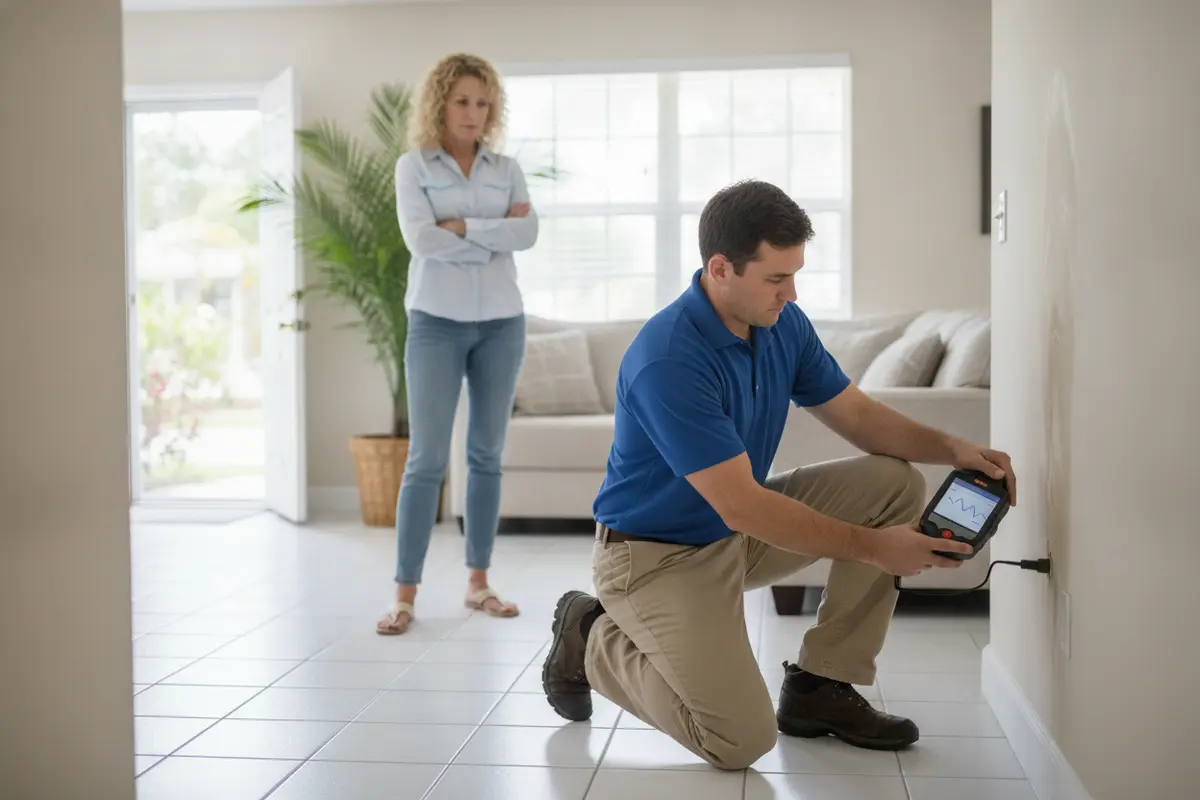
For example, a pressure test may help determine whether a line is losing pressure. Locating equipment can help narrow where a detectable signal is strongest. Neither result automatically proves which repair is appropriate. The test sequence matters: a specialist may use one result to decide whether another test is warranted, rather than treating every tool as a definitive answer. Pipe Surgeons explains hydrostatic leak detection and offers camera inspection services. A camera can inspect accessible pipe interiors, but it cannot simply see through concrete; ask whether it applies to the line and access points involved.
Compare providers by how they connect a test result to a conclusion, not by the number of devices listed. Ask for the locations tested, what the results indicate, and whether there are reasonable alternative explanations. A useful report can be brief, but it should let you understand how the recommendation was reached. If the result is inconclusive, ask what additional evidence could narrow the question and whether that step changes the expected access or cost.
For context on consumer decisions, the Federal Trade Commission's guidance on choosing a contractor recommends checking references and getting written estimates. Apply that general advice alongside the technical questions specific to pipe diagnostics; a contractor checklist cannot replace an explanation of the test findings.
How can you compare repair approaches?
Once the leak and affected line are better understood, the specialist should explain the repair choices that fit the actual pipe, its condition, access, and location. A focused repair may address a defined damaged area. A broader replacement or rehabilitation approach may be considered when the assessment points to more extensive concerns. Neither option is automatically right for every property.
| What to compare | Focused repair | Broader replacement or rehabilitation |
|---|---|---|
| Scope | Addresses a defined damaged area or leak | May address a longer section or multiple concerns |
| Evidence needed | Clear location and understanding of the affected line | Assessment of pipe condition and route, plus access requirements |
| Questions to ask | What is included, and how will the repair be checked? | Why is broader work proposed, and what alternatives were considered? |
| Property impact | Ask what access and restoration may be needed | Ask how the method affects the slab, finishes, and surrounding area |
| Decision point | Does evidence support a limited repair? | What indicates that a longer-term approach should be evaluated? |
This table is a conversation guide, not a promise that either option will suit a particular property. A specialist should explain the evidence behind the proposed scope and identify conditions that could change it. Review Pipe Surgeons' information about trenchless pipe repair and CIPP pipe lining as background. Trenchless methods are not automatically appropriate for every slab leak; the pipe and access conditions matter.
What should a written proposal include?
Request a written proposal that connects diagnostic findings to the recommended work. It should make the scope understandable before you approve it. When comparing proposals, line up equivalent details instead of choosing by headline price alone. If one quote describes a test and repair while another describes repair only, they are not necessarily comparable.
- Findings: What was tested, what was found, and where the affected line is believed to be.
- Scope: Which tasks are included and excluded, including any follow-up diagnosis.
- Method: Why the approach fits the pipe and site conditions, and what alternatives were considered.
- Access and restoration: What may need to be opened, moved, or restored, and who is responsible for each part.
- Testing: What checks will be performed after repair and how the results will be communicated.
- Uncertainties: What could not be confirmed and what might change the work.
- Price and terms: What the quote covers, potential additional work, and payment terms.
Ask how the provider will handle a finding that changes the scope after access begins. Confirm whether you will be contacted before additional work is authorized, and how any revised price will be documented. Do not assume the lowest quote covers the same diagnostic work, materials, access, restoration, or follow-up as another proposal. Ask each provider to clarify differences in writing. Pipe Surgeons provides financing information for customers evaluating payment options.
Which questions help identify a good fit?
Use the same core questions with each provider. Consistency helps reveal differences in process and makes it easier to compare what is actually included. Notice whether answers are direct, specific to your situation, and understandable without technical shorthand.
- What evidence points to a leak beneath the slab?
- Which tests do you recommend, and what will each result tell us?
- How will you locate the affected section and explain uncertainty?
- What repair options are relevant to this pipe, and why?
- What disruption, access, and restoration should I plan for?
- What is included in the written price, and what could change it?
- How will you verify the work and explain the result?
- Who should I contact if symptoms continue or return?
Check the provider's relevant experience and service area, and ask who will perform the assessment. Pipe Surgeons describes its company background, pipe services, and service areas online. Reviews can offer context about communication, but they do not establish what is happening beneath your particular slab.
How can you prepare for an assessment?
A few details can help the technician focus the investigation. Note when the issue began, whether it changes over time, and which fixtures or areas seem affected. Keep water bills or prior inspection notes available if they help explain a pattern. A timeline is often more useful than a vague recollection: record dates, visible changes, and any relevant work performed near the affected area.
- Mark visible dampness or warm areas without covering or altering them.
- List changes in water use, sounds, or fixture behavior that you have noticed.
- Gather prior repair records, plans, or reports if available.
- Make access to relevant rooms and shutoff points possible.
- Write questions about testing, repair scope, property access, and follow-up.
Do not cut into a floor or authorize a repair based only on a surface symptom. If water is actively spreading or causing immediate damage, contact a qualified service provider promptly and take reasonable steps to protect people and belongings. If you must shut off water to limit active leakage, follow the property's known shutoff procedure when safe to do so, and tell the technician what you did and when.
How do sample situations change the comparison?
Examples can help show why a specialist should tailor the next step rather than use the same repair recommendation for every symptom. They are illustrations, not diagnoses; each property needs its own assessment.
A warm area appears, but there is no visible water
A warm patch might lead a homeowner to suspect a hot-water line, but temperature alone does not confirm the source. A useful conversation asks where the patch is, whether it changes, what other symptoms exist, and which test can distinguish possibilities. Avoid approving a floor opening solely because one area feels warmer than another.
A water-use pattern changes without an obvious wet spot
Unexplained water use may justify checking the system, but it does not identify a slab leak by itself. Share the timing and any known changes in household use. Ask whether the proposed test can isolate the line or help determine whether the suspected leak is elsewhere. The written findings should say what the test established, not just repeat the original suspicion.
Moisture is visible near a wall or floor edge
Visible moisture can have several causes, so its location alone may not reveal whether a buried water line is involved. The specialist should consider the affected area and accessible plumbing, describe what evidence supports the diagnosis, and explain whether additional investigation is needed before selecting a repair method.
A first test suggests a leak, but the location remains uncertain
That is a reason to ask what the first result can and cannot show. A second test or a more focused locating step may be useful, depending on the system. Ask for the purpose, likely access needs, and cost implications before proceeding. Clear limits are a sign of a careful process, not a failure to offer an instant answer.
How should you assess service fit and follow-up?
The best company for slab leak repair is not simply the provider with the most confident claim or the longest equipment list. Look for a match between the issue and the company's pipe specialty, an explanation you can follow, and a proposal that makes responsibility clear. Pipe Surgeons presents itself as a specialty pipe diagnostics and repair provider, so ask whether the suspected condition fits the team's scope and service area.
Before approving work, clarify the next steps in sequence: what will happen first, what decision depends on the result, and when you will be asked to approve a change. Ask who communicates findings, whether testing after repair is included, and how the result will be recorded. These details matter because diagnosis, access, repair, and restoration may involve different tasks.
For a property owner comparing more than one provider, keep a simple record with one column per company. Note diagnostic steps, stated findings, proposed method, access, exclusions, post-repair checks, and open questions. This turns sales conversations into a practical comparison and makes missing details visible before you commit.
Talk with Pipe Surgeons about your pipe concerns
Frequently asked questions
Is the first sign of moisture proof of a slab leak?
No. Moisture can have more than one source. Testing and assessment help determine whether a water line beneath the slab is involved.
Can a specialist identify the exact leak without opening the floor?
Diagnostic tools can help narrow a suspected leak's location, but what can be confirmed depends on the pipe, access, and test results. Ask the specialist to explain the findings and any remaining uncertainty.
Does trenchless repair work for every slab leak?
No. The appropriate method depends on the pipe, damage, route, and access. Ask why a proposed method fits the specific conditions and what alternatives were considered.
Should I choose the lowest estimate?
Compare the diagnostic work, repair scope, access, testing, exclusions, and terms as well as price. Ask providers to clarify differences so you are comparing similar work.
Plan a clear next step
Comparing specialists is easier when you have a documented diagnosis, an understandable repair scope, and answers to questions about property impact and verification. A focused conversation can help determine whether an assessment is appropriate and what information to gather before deciding.
Request a conversation about slab leak concerns
Take time to compare the evidence and scope, then choose a next step you understand.