

Bullseye leak detection sounds like a promise to locate a leak with pinpoint accuracy. For South Florida and Treasure Coast property owners, it is better understood as a focused diagnostic goal: use the available clues and suitable tests to narrow the search, then explain what the evidence does and does not establish. The useful question is not whether one device can find every leak instantly, but how a specialist will move from a symptom to a defensible next step.
Request a focused leak detection conversation
What does “bullseye” mean in a leak search?
“Bullseye” is a plain-language way to describe a targeted search. It is not, by itself, the name of one universal test, nor does the phrase guarantee that a leak can be identified at an exact point without uncertainty. The value of a focused investigation is that it uses observations and diagnostics to reduce guesswork before repair decisions are made.
A visible stain, damp patch, unexplained water use, or sound of running water can be an important clue. It may not mark the opening in a pipe. Water can move through soil, along a slab, or inside a wall before it appears at the surface. The place where a symptom becomes visible and the place where water escapes may therefore differ.
Pipe Surgeons focuses on specialized pipe diagnostics and repair, rather than presenting every concern as the same kind of service call. Its leak detection service overview describes a relevant starting point for discussing a suspected leak. An initial conversation should clarify the observed symptom, the systems that may be involved, what access is available, and what investigation may help. It should not present a remote guess as a confirmed diagnosis.
That distinction matters because “leak” can describe different situations: a pressurized water line, a drain or sewer path, or water entering from another source. Each calls for a different question. A focused search begins by identifying which system is reasonably suspected, then chooses a test that can address that question.
What information helps narrow the search?
Before requesting an assessment, collect observations in a simple timeline. The goal is not to diagnose the problem yourself. It is to give the technician useful context and reduce the chance that an important clue is overlooked. Write down when the concern began, whether it changes, and what conditions were present when it appeared.
- Location: Note where water, dampness, discoloration, sound, or odor is noticed. Record whether it is indoors or outside, near a fixture, over a slab, by a utility area, or in a shared space.
- Timing: Is the sign constant, intermittent, or associated with a particular use of water? Record approximate times and whether the condition changes when the property is quiet.
- Extent: Describe what has changed and how far the affected area seems to extend. A photo with a date can help document changes, but do not cover or disturb a suspected hazard.
- Recent events: Mention known work on pipes, changes in building use, unusual pressure observations, or other events that may provide context. Avoid assuming that a recent event caused the symptom.
- Prior findings: Gather earlier reports, test results, repair notes, or relevant bills if available. A specialist can consider what has already been checked rather than treating every visit as a blank slate.
- Access: Identify shutoff locations, utility areas, cleanouts, gates, restricted rooms, and operating hours. Do not enter a confined or unsafe space just to collect information.
If you can safely observe a water meter or shutoff, record what you see and when. Do not dismantle equipment or operate a valve if you do not know its purpose. A change in a meter reading can be useful context, but it does not, on its own, locate a leak or identify the affected pipe. For wider household water-use information, the U.S. Environmental Protection Agency is a government resource; general conservation information is not a substitute for a property-specific pipe assessment.
Describe observations rather than theories. “There is a damp area near the hallway that became visible Tuesday” is more useful than “the pipe under the hallway is definitely broken.” If water is near electrical equipment or creates an immediate safety concern, prioritize safety and contact an appropriate emergency professional rather than waiting for a routine diagnostic discussion.
Which tests might be considered?
There is no single method that answers every leak question. Testing depends on the suspected system, the available access, the observed conditions, and what the technician needs to establish. Pipe Surgeons’ diagnostic work may involve hydrostatic, smoke, or electronic testing. Those methods do not answer identical questions, and a method should be selected because it fits the situation—not because its name sounds precise.
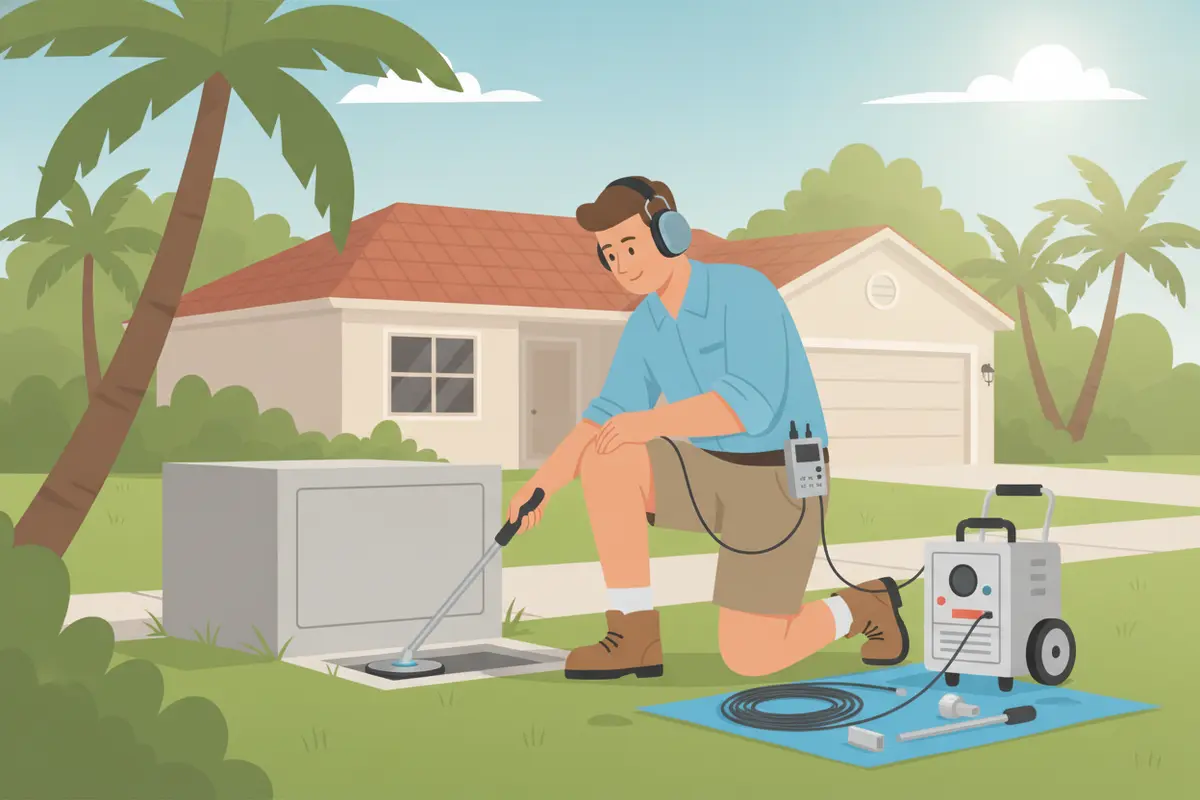
A pressure-related or hydrostatic test can help assess whether a defined section holds pressure under the test conditions. Electronic listening or detection equipment may help narrow a likely location by identifying signals associated with escaping water. Smoke testing can help investigate potential pathways in a compatible system. A camera inspection can provide a view inside an accessible sewer or drain line, but it answers a different question from an electronic test on a pressurized water line. The camera inspection overview explains that separate diagnostic option.
| Assessment element | What it may help clarify | Question to ask |
|---|---|---|
| Symptom and site review | Which area or pipe system merits attention | What observations are guiding the initial focus? |
| Hydrostatic or pressure testing | Whether the tested section holds pressure under the test conditions | Which section is being tested, and what does the result establish? |
| Electronic detection | Whether equipment can help narrow a likely leak location | What conditions might affect the reading? |
| Smoke testing, where suitable | Potential pathways in a compatible system | Is this test appropriate for the suspected system and question? |
| Camera inspection | Visible conditions inside an accessible drain or sewer pipe | What portions of the line can the camera reach and show? |
| Follow-up inspection | Whether more evidence is needed before repair planning | What options remain if the source is still uncertain? |
This is a comparison aid, not a mandatory sequence. A test can produce a useful result without revealing an exact opening. For example, it may indicate that one isolated section needs further attention, while leaving the precise source unresolved. Ask what the method is intended to establish, what access it needs, and which limitations apply at your property.
Also ask whether a test could be affected by site conditions, system configuration, or the ability to isolate a section. The answer should be specific to the proposed test. If a method is not suitable, a technician should be able to explain why another approach may be more useful. For relevant pipe issues beyond detection, Pipe Surgeons describes its broader pipe repair and inspection services.
How should you interpret a test result?
A result is useful when it connects evidence to a practical next step. Ask for a clear account of what was examined, what method was used, what was observed, and how certain the conclusion is. A finding can be confirmed, probable, or still inconclusive; those categories should not be blurred together.
- Confirmed observation: A result directly shows or measures something under the stated test conditions. Ask which part of the system the observation covers.
- Likely explanation: Several clues point toward a source, but the precise opening or pathway has not been directly confirmed. Ask what additional evidence would strengthen the conclusion.
- Unresolved question: The test did not settle the issue or was limited by access or conditions. Ask what the next useful check would be and whether another system should be considered.
Do not treat “we narrowed it down” as the same as “the exact repair point is confirmed.” If a repair proposal depends on a particular location, ask how that location was established and whether more inspection is needed first. A good explanation should make it possible to distinguish the evidence from the interpretation and the interpretation from the proposed work.
Keep a copy of the findings and note the date, tested area, method, and any stated limits. If more than one person manages the property, share the same summary with the people approving access or repairs. This is especially helpful for a facility team that has work orders, tenant reports, or operating constraints to coordinate.
How do example situations change the investigation?
The same visible sign can lead to different diagnostic questions. These examples show why a focused investigation starts with context instead of assuming a location or a test.
A damp patch appears near a wall
A homeowner notices a growing damp area near an interior wall. The mark provides a location for observation, but it does not prove a pipe is directly behind that spot. The assessment may begin by documenting where and when the dampness appears, identifying nearby water lines or drains, and asking whether the condition changes with water use. If a particular pipe system becomes the reasonable focus, the technician can explain what test could help evaluate it. The practical endpoint might be a narrower area for follow-up, not an instant guarantee of the exact leak point.
Water use seems unusual, but no wet area is visible
A property owner notices a change in water use without seeing moisture. The first task is to record the observation and check whether ordinary use or a fixture could explain it. If the concern persists, share the timeline and any safe meter observations with the specialist. An unexplained change may justify investigation, but it does not alone establish that a concealed pipe is leaking. The test plan needs to fit the suspected supply system and available access.
A commercial site has a recurring symptom
A facility team may have multiple reports from different rooms, operating schedules, and restrictions on access. Assign one person to consolidate dates, locations, and previous findings. Identify areas that must remain open, times when testing could disrupt operations, and who can authorize access. If the observations implicate a drain or sewer instead of a pressurized water line, a different diagnostic question may apply. Pipe Surgeons serves residential, commercial, industrial, and municipal clients; the appropriate approach depends on the site and the pipe system.
In all three situations, the goal is the same: reduce uncertainty enough to make an informed decision. The right next step could be more testing, a visual inspection, or discussion of a repair after the source is sufficiently understood. Detection and repair are related but separate decisions. A diagnostic finding does not automatically establish which repair is appropriate or whether a trenchless option fits. For applicable conditions, review the company’s information about trenchless pipe repair and pipe bursting as separate repair approaches, not as a diagnosis.
How can you prepare for a service conversation?
A short, organized conversation helps establish whether the concern fits specialized pipe diagnostics and what information should be available for an assessment. You do not need to name a test in advance. Explain the signs and ask how the next step will answer the specific question at the property.
- State the observed issue. Describe what you see, hear, or have measured. Give dates and changes, and separate direct observations from assumptions.
- Identify the property and affected areas. Explain whether the concern is in a home, business, industrial building, or municipal setting. Note spaces that are occupied, sensitive, or difficult to access.
- Share relevant records. Provide prior test reports, repair notes, and the timeline of earlier visits if available. Keep original documents and ask whether photos or plans would be useful.
- Ask what the assessment is meant to determine. Find out which pipe system is under consideration, why a particular method may fit, and what the method cannot establish.
- Clarify access and coordination. Ask which rooms, shutoffs, or access points need to be available and who should be present. For a managed site, name the person coordinating entry and operating constraints.
- Agree on how findings will be explained. Ask what will be documented, how uncertainty will be described, and what decision may follow if the source is narrowed but not confirmed.
Property owners in the company’s service territory can review the service area information and background on Pipe Surgeons before reaching out. If the suspected issue involves water infrastructure, the water services overview may help frame the conversation; if observations point toward a drain, see the drain services information. These pages provide context, not a remote determination of what has failed.
For any proposed work, ask for a clear separation between the diagnostic findings and repair options. The repair discussion should account for what is known about the pipe and what further confirmation might be needed. If you are comparing options, ask what conditions each option requires and what the stated scope includes. Do not infer that a trenchless method is automatically suitable just because a leak has been detected.
Frequently asked questions
Discuss your leak detection needs
Does bullseye leak detection guarantee an exact location?
No. The phrase describes a focused goal, not a universal guarantee. Results depend on the pipe system, site conditions, available access, and method. Ask what the evidence supports and what uncertainty remains.
Can a stain show where the pipe is leaking?
A stain is a useful clue, but water can travel before it becomes visible. The visible symptom may not identify the opening, so the system and surrounding conditions may need to be assessed.
Should I ask for one specific test?
Start by describing the signs and asking which test, if any, fits the question. Pressure-related, electronic, smoke, and camera methods address different conditions. A proposed method should have a clear purpose and stated limits.
What should I have ready before booking?
Prepare the symptom’s location and timing, any safe observations, access details, and prior reports or repairs. Do not enter unsafe areas or delay urgent safety measures to gather information.
Does locating a suspected leak decide the repair?
No. Detection helps clarify where or what to investigate; repair selection depends on the pipe, the findings, and the conditions at the property. Ask whether the location is sufficiently confirmed before approving work that depends on it.
Plan a clear next step
A careful leak investigation starts with specific observations, a test suited to the suspected system, and a plain explanation of what the findings establish. It should also identify the limits of the assessment and the questions that remain. When you are ready to discuss a suspected pipe leak, contact Pipe Surgeons with the details you have so the conversation can focus on the property and the next useful diagnostic step.
Contact Pipe Surgeons about leak detection
A focused search is most useful when the evidence, uncertainty, and next action are all clear.