
How long is the cast iron pipe lifespan, and what should a Florida property owner do when those pipes grow older? There is no single age at which every cast iron line fails. Pipe use, installation, environment, maintenance, and current condition all matter. Knowing the system’s age can help you plan, but symptoms and inspection findings are more useful for deciding what to do next.
Request an inspection conversation
How long can cast iron pipes last?
In short: Treat published lifespan figures as context, not a countdown for your specific pipe. A condition assessment is needed to understand an individual system.
Cast iron has been used in building drainage and water systems for many decades. Some lines remain in use long after installation; others develop problems earlier. A number quoted for one kind of pipe cannot reliably predict the remaining service life of another. A buried water main, a private sewer lateral, and a drain line beneath a building have different jobs and operating conditions.
Published figures illustrate that variation. The City of Newport, Rhode Island, lists an average useful lifespan of 120 years for cast iron pipes in its drinking-water system information. A Minnesota legislative project summary gives a typical 50-to-80-year lifespan for cast iron water mains. These are different public water-system references, not warranties or forecasts for a private building drain. Brevard County’s private sewer lateral information says those pipes may last up to 50 years under ideal circumstances, while noting they can break down sooner. The specific material, use, and local conditions matter.
For a Florida property, the practical question is not simply whether the pipe has reached a certain birthday. It is whether the line is showing symptoms, whether inspection finds a defect, and whether the issue is isolated or recurring. If records do not show the pipe material or installation date, avoid assuming based on the building’s age alone.
It also helps to identify which part of the system you mean. A building’s drain piping may include interior branches, a larger building drain, and a buried private lateral leading away from the structure. These sections can have different access points and conditions. A concern in one section does not establish that every cast iron pipe on the property needs the same response. If you are not sure where a line runs, tell the inspector what you know and ask which sections the proposed evaluation can reach.
Age can still be useful for planning. If records suggest a system is older, you can organize maintenance records, keep an eye on recurring symptoms, and learn how an assessment would work before an urgent backup occurs. That is different from treating an age estimate as a deadline. The aim is to replace uncertainty with property-specific information.
For background on the public-system lifespan references, see the Newport Department of Utilities drinking-water system information and the Minnesota 2026 watermain project summary. For a private lateral perspective, consult Brevard County’s private sewer lateral guidance.
What can shorten or complicate the expected lifespan?
In short: Age is only one part of the picture; operating conditions and the type and location of the pipe influence what an inspection may find.
Cast iron pipes can face several sources of wear and deterioration. The effects are not identical in every property, and an exterior symptom may have more than one possible cause.
- Corrosion and interior wear: The pipe’s inside surface can change over time. Deposits and rough areas may affect flow and can make recurring drainage trouble more likely.
- Wastewater exposure: Drain lines carry waste and water through repeated cycles. The conditions inside a drain line differ from those in a supply pipe.
- Ground movement or settlement: Shifts around a buried line may affect alignment or connections. A change in slope can interfere with drainage.
- Roots and external pressure: Roots can enter through an opening or joint, while ground loads and nearby work may put stress on buried sections.
- Previous repairs and connections: A system may include sections of different materials or past repairs. Transitions and joints deserve attention as part of the overall picture.
- Use and maintenance history: Repeated blockages, past backups, and earlier repair work can help explain current symptoms and guide the inspection.
Florida conditions do not create one uniform lifespan for every property. The line’s route, depth, installation, surrounding soil, usage, and maintenance history all contribute. A technician needs to examine the evidence at the property rather than infer the condition from regional generalizations.
These factors can interact. For example, recurring blockages may be related to deposits inside a pipe, a change in alignment, an obstruction, or another part of the drain system. A tree near a buried route may raise a question about roots, but proximity alone does not prove that roots have entered the line. The value of a diagnostic visit is to test a reasonable explanation against what can actually be observed, not to jump from a single clue to a full replacement recommendation.
Which warning signs deserve attention?
In short: Recurring symptoms, multiple affected fixtures, and changes that keep returning are good reasons to investigate the line rather than repeatedly treating the visible symptom.
A slow fixture by itself does not prove a cast iron pipe has failed. A local clog or another issue may produce similar signs. Look for patterns and note when symptoms occur.
- Drains repeatedly slow down or clog after being cleared.
- More than one fixture drains poorly at the same time.
- Wastewater backs up at a low drain or another fixture.
- Unusual sewer odors persist or return after basic cleaning.
- There are wet areas, unexplained dampness, or signs of a leak along a known pipe route.
- Drain problems recur in the same area despite prior service.
Pay attention to timing and location. Record which fixtures are affected, whether the problem is constant or intermittent, and what work has already been done. If a backup is active or water is damaging the building, treat it as an urgent problem and contact a qualified service provider promptly. Avoid repeated chemical treatments or forceful do-it-yourself attempts when the cause is unknown; they may not address a damaged line and can complicate diagnosis.
When is an inspection worth considering?
In short: Consider inspection when symptoms repeat, the pipe’s history is unclear and planning matters, or you need evidence before choosing a repair response.
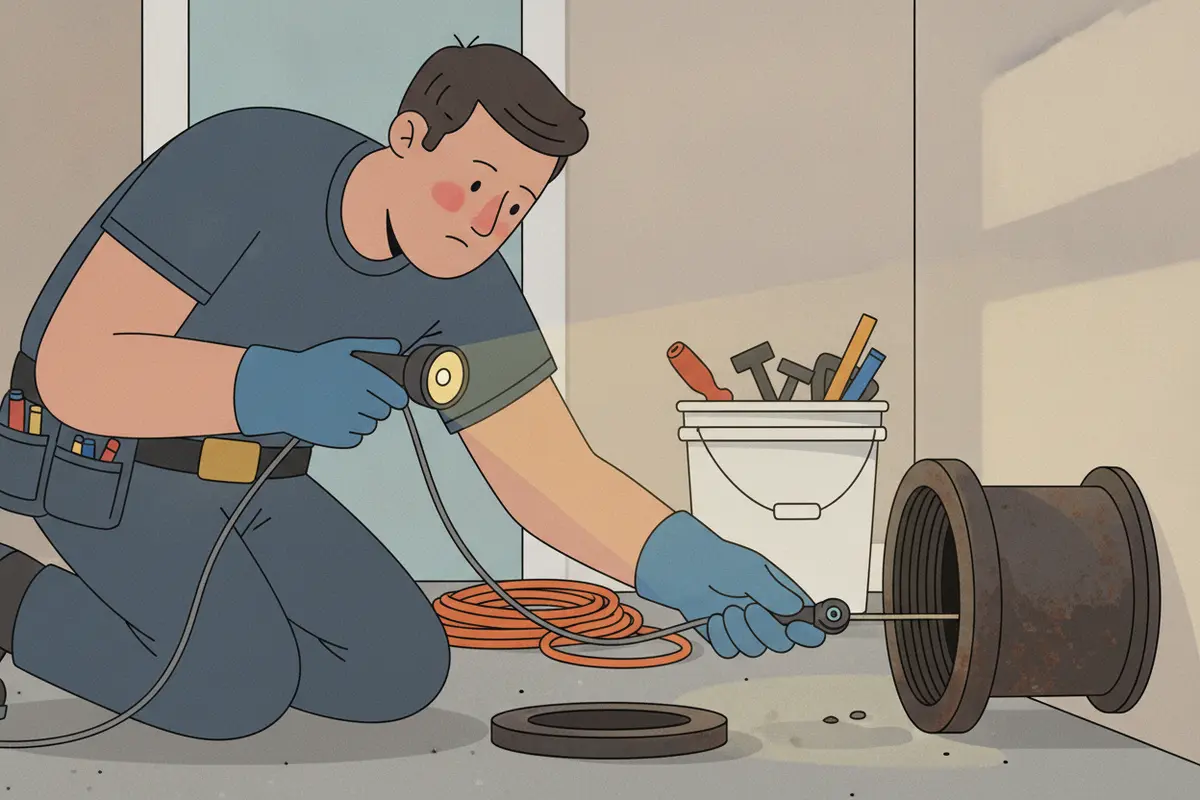
An inspection can help locate the affected section and distinguish a line issue from a symptom that originates elsewhere. It is especially useful when a property has a recurring blockage, a suspected leak, multiple affected drains, or a repair decision that depends on the pipe’s actual condition. A camera inspection can show accessible sections of a drain line, while other diagnostic methods may be appropriate depending on the suspected problem and pipe location.
Inspection does not guarantee that every part of a system can be viewed or that every defect can be identified in a single visit. Access, pipe layout, standing water, debris, and the condition of the line can affect what is visible. Ask what area was inspected, what could not be assessed, and whether the findings support a clear next step.
When reviewing the findings, ask for the location of any concern, what visual evidence supports it, and whether the report distinguishes an observed defect from a possible cause. If a camera reaches only part of the line, ask what additional access or testing could provide more information. If the inspection finds a localized concern, ask whether adjacent sections were checked and what that means for the proposed scope. These questions help you understand both the result and its limits.
A useful assessment should leave you with a clear explanation in plain terms: what was checked, what was found, what remains uncertain, and what next step is being proposed. If the findings point toward a repair, ask how the proposed method relates to the specific pipe condition and access. You can then compare the recommendation with the property’s operating needs and any earlier repair history.
Pipe Surgeons provides camera inspection services and leak detection services. Learn about the company’s trenchless pipe repair approach and its broader pipe repair and inspection services. The right diagnostic method depends on the problem and where it is occurring.
What should you prepare before requesting an assessment?
In short: A brief symptom history, prior work details, and access information help focus the conversation and set expectations.
Before arranging an assessment, gather what you know. You do not need a complete building record to start, but these details can help:
- Describe the symptoms. Note which drains or areas are affected, how often it happens, and whether it is getting worse.
- List previous work. Share past clearing, repairs, replacements, or inspections and any reports or video you have.
- Identify known access points. If you know where cleanouts or inspection openings are, mention them. Do not open an unfamiliar or unsafe access point.
- Explain the property context. State whether the issue is in a home, business, facility, or shared system, and identify any access or operating constraints.
- Ask what the inspection can establish. Clarify which sections can be evaluated, what limitations may apply, and how findings will be presented.
Photos of visible signs can help document a change, but they do not replace inspection of the pipe. Keep records of dates and symptoms, particularly if the issue is intermittent. A careful history makes it easier to compare future findings and avoid repeating steps without learning more.
How do planning choices compare?
In short: Monitoring, investigating, and repairing serve different needs; base the choice on symptoms and documented condition, not age alone.
| Planning choice | When it may fit | What to consider |
|---|---|---|
| Keep records and monitor | No current symptoms and no known defect, but pipe history or age is a concern. | Track changes and retain property or repair records. Monitoring does not establish hidden pipe condition. |
| Arrange diagnostic inspection | Symptoms repeat, the source is uncertain, or an upcoming decision needs better evidence. | Ask what sections can be reached and what the inspection will and will not show. |
| Plan a targeted repair | Inspection identifies a localized defect and the affected area is understood. | Discuss the scope, access, expected disruption, and how adjacent sections will be evaluated. |
| Compare broader rehabilitation or replacement options | Findings indicate a more extensive issue, or repeated localized work is not resolving it. | Compare options against the specific pipe layout, condition, access, and property needs. |
One way to avoid comparing unlike proposals is to ask each provider to describe the same basics: the pipe section involved, the evidence for the concern, the recommended work, access needs, and any limitations. Also ask what happens if the work reveals a condition different from what was expected. The answers can help distinguish a narrowly focused response from broader rehabilitation without assuming that the larger scope is always necessary.
This is a planning framework, not a diagnosis. One repair method will not fit every cast iron system. Pipe lining and pipe bursting are specialized approaches that may be considered when the site and line conditions suit them; they are not automatic choices based on pipe age. Pipe Surgeons explains CIPP pipe lining and pipe bursting in more detail. A field assessment helps establish whether either approach is appropriate.
How can you plan without overreacting to age?
In short: Use age as a prompt to gather information and budget thoughtfully, not as proof that the line has failed or must be replaced.
If you own or manage a property with older cast iron lines, a simple plan can reduce last-minute uncertainty. First, gather available installation, repair, and inspection records. Next, note any recurring symptoms and their locations. If there are no signs of trouble, keep the records organized and ask a specialist whether a proactive assessment makes sense for the property. If symptoms appear, request a focused evaluation before committing to a major scope of work.
When comparing proposals, look for a clear description of the diagnosed issue, the section involved, the recommended scope, and any limits on the proposed work. Ask whether the recommendation addresses a confirmed defect or is based on an assumption about age. If multiple options are presented, ask how each fits the pipe’s condition and access. You can review Pipe Surgeons’ company background and service areas while considering who to contact.
A reasonable plan leaves room to update decisions as evidence changes. A line that has no symptoms may need documentation rather than immediate work. A line with recurring backups or visible damage merits attention even if its exact age is unknown. The aim is to identify the condition, understand practical options, and make a decision that fits the property.
Talk with Pipe Surgeons about an assessment
Frequently asked questions about cast iron pipe lifespan
In short: No lifespan figure or symptom can replace an evaluation of the actual pipe and its use.
Does reaching a certain age mean cast iron pipes need replacement?
No. Age can be a reason to review records or consider an assessment, but it does not confirm failure. Condition, symptoms, pipe location, and inspection findings help determine the next step.
Can slow drains tell me that a cast iron line is failing?
Not on their own. A slow drain can have several causes. Repeated problems, multiple affected fixtures, or backups make it more important to investigate the source rather than assume the pipe material is responsible.
Are lifespan estimates for water mains useful for a home drain line?
Only as broad context about how reported service life varies. Public water mains and private building drains do different jobs and experience different conditions, so a water-main estimate should not be used as a prediction for a home’s drain pipe.
What does a camera inspection tell me?
It can show accessible portions of a drain line and help identify visible conditions. Access and line condition can limit what is seen, so ask which sections were checked and whether additional evaluation is needed.
Should I wait until there is a backup to investigate?
No single timeline suits every property. If symptoms are recurring or worsening, an assessment can help clarify the problem before it becomes an urgent disruption. If there are no symptoms, use available records and professional guidance to decide whether proactive inspection is appropriate.
Get a clearer picture of an aging pipe system
In short: Pair the pipe’s history with current symptoms and inspection findings to make a more informed plan.
Request help evaluating your pipe concerns
Cast iron pipe lifespan varies from system to system, so a property-specific assessment is the most useful way to understand what your pipes may need next.