

If you are comparing hydrostatic leak detection companies, first ask what section of piping will be isolated and what the test can establish. A pressure change may help identify a concern in a defined system, but it does not automatically locate a leak or explain its cause. For South Florida and Treasure Coast property owners, a useful evaluation connects testing to a diagnostic plan and clearly describes what remains uncertain.
What does hydrostatic leak testing examine?
Hydrostatic testing generally involves filling or pressurizing a defined section of piping with water, then observing whether pressure holds over a specified period. A pressure loss can indicate that the section is not holding as expected. It may point to escaping water, but the test setup or another component can also affect a measurement. The result must be interpreted in context.
Ask the provider to define the test boundaries. Which line is isolated? Which valves, fixtures, or connections are included? Does the section correspond to the symptoms you reported? A result from one isolated run does not necessarily describe every pipe on the property. This is especially important when a building has multiple branches, additions, or separate water systems.
Hydrostatic testing is not the same as observing a wet area or an unusual bill. Those clues can help guide an investigation, but they do not measure a particular pipe section under controlled conditions. A company may use more than one appropriate method, depending on the system and findings. Pipe Surgeons outlines its service context on its leak detection services page.
In short: The method tests a defined section under stated conditions. Start by finding out exactly which section and why it is relevant to your symptoms.
How should you compare hydrostatic leak detection companies?
Compare the diagnostic process and the clarity of communication, not just the name of a test. Before scheduling, ask the company to explain how it will connect your reported symptoms to the proposed test. A useful response should be understandable without requiring you to know technical terminology.
- What section will be tested? Ask how the technician will identify and isolate the line, and whether that section relates to the area of concern.
- What does a pressure change establish? A careful answer separates the measurement from a confirmed leak location or cause.
- What might affect the result? Ask about connections, valves, fixtures, access, and condition of the system as relevant to the setup.
- What happens if the result is unclear? Find out whether the company may recommend another method, a changed test boundary, or further evaluation.
- How will findings be explained? Confirm whether you will receive a written summary or a clear verbal explanation of observations, limits, and next steps.
- How does diagnosis connect to repair? Testing and repair are separate decisions. Ask what further evidence is needed before a repair approach is selected.
Review the company’s broader pipe repair and inspection services and its company background for context. A focused explanation of the proposed diagnostic work is more useful than a broad claim that one method suits every pipe or property. You can also ask who will be your point of contact for explaining the test and whether the person discussing repairs will refer to the actual findings.
Compare answers side by side rather than relying on memory. After each call, note the stated test boundary, what the company says a pass or pressure loss could mean, and what would happen next. If one company describes a test as a complete answer but another explains its limitations, ask each to clarify the difference. The goal is not to reward the most confident pitch; it is to understand what work is proposed and what evidence you will receive.
In short: Compare the proposed process, boundaries, explanation, and follow-up plan. Look for specific answers that fit your property rather than a universal promise.
What does a pressure test result mean?
A result is meaningful only alongside the section and conditions tested. If pressure falls, the system may not be holding as expected. That observation does not necessarily distinguish a pipe leak from a test connection or another component within the isolated section. If pressure holds, the finding applies to the tested section and timeframe; it cannot rule out a concern elsewhere or under different conditions.
Ask the technician to separate observations from conclusions. “Pressure declined in the isolated section during the test” describes an observation. “The leak is below the kitchen floor” is a location claim that may require additional evidence. You can ask what supports the conclusion, what alternatives remain possible, and what step would narrow the uncertainty.
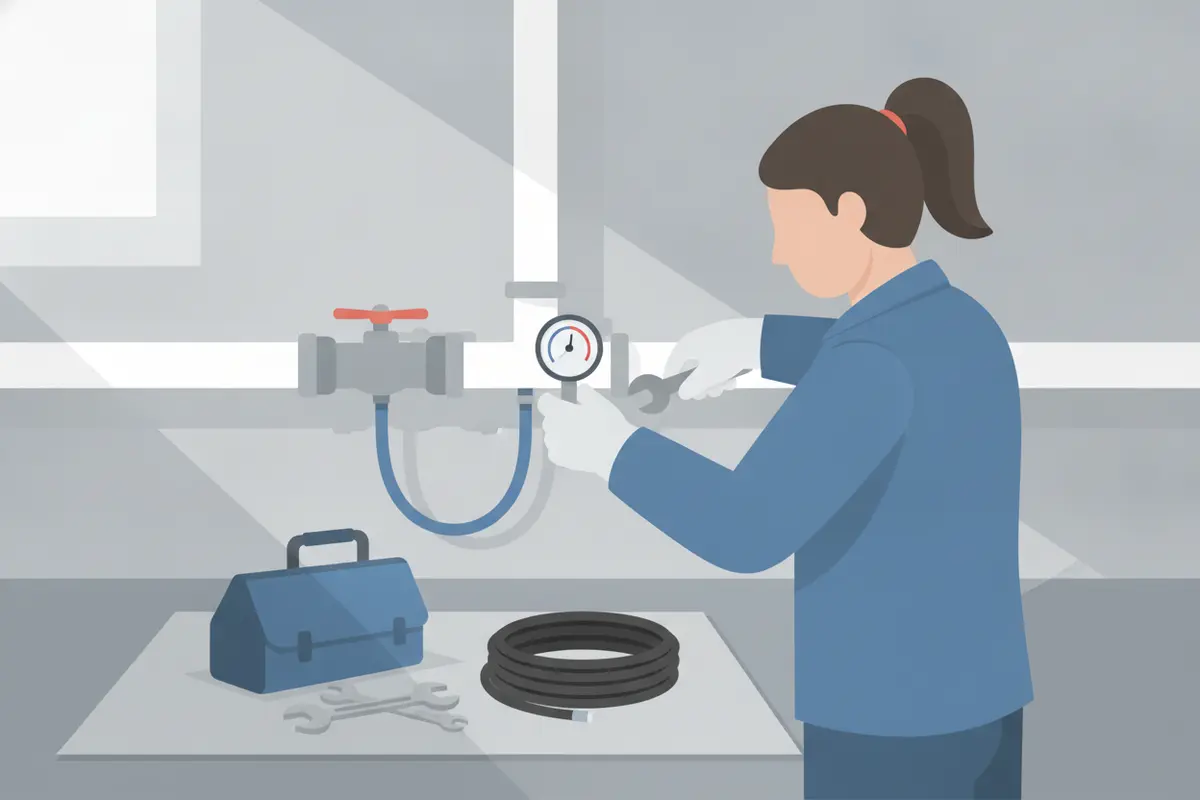
Academic work describing hydrostatic pressure and leak testing concerns field-erected or modified industrial refrigeration piping systems, not every residential water line. Its limited scope is a useful reminder to check whether a source applies to the system being assessed: pressure and leak testing.
It can help to think of the result as one piece of a decision rather than a verdict. A pressure change may give a reason to investigate further. A stable reading may narrow the question to another branch or another set of conditions. The result does not, on its own, establish how a repair should be performed or whether a specific area must be opened. Those decisions require a clear connection between the observed evidence and the proposed action.
In short: Ask what was measured, where, and under which conditions. Then distinguish that observation from any claim about a precise location, cause, or repair.
How do common diagnostic approaches compare?
Different tools answer different questions. The relevant option depends on the piping, symptoms, access, and previous findings. Use this comparison to ask about purpose and limits; it is not a recommendation to apply every method to every property.
| Approach | What it may help assess | What to clarify |
|---|---|---|
| Hydrostatic pressure test | Whether an isolated, water-filled section holds pressure under test conditions | Boundaries, duration, setup, interpretation, and limitations |
| Electronic or acoustic detection | Signals that may help narrow a suspected area, depending on site conditions | What is measured and whether findings need confirmation |
| Camera inspection | Visible interior conditions in an accessible sewer or drain line | Whether the relevant line is accessible and what the camera can show |
| Visual inspection and symptom review | Visible moisture, site conditions, and reported symptom patterns | What further testing is needed to verify a pipe concern |
These approaches are not interchangeable. A sewer camera, for example, is not a universal tool for pressurized water piping. Pipe Surgeons’ camera inspection information describes a different diagnostic context; its water services page may help frame a conversation about a water-line concern.
Consider a reported damp spot near a bathroom. A visual review may help describe the surrounding conditions, while a test on an isolated supply section may address whether that particular line holds pressure. A camera may be relevant if the concern instead involves an accessible drain or sewer line. The question is not which tool sounds most advanced. It is which tool addresses the suspected system and what its finding can establish.
When a provider proposes more than one method, ask what question each step answers and how the results will be combined. For instance, one step might narrow the system under investigation while another may help assess an accessible line. If the proposed tests seem unrelated to your reported symptoms, ask the provider to explain the connection before agreeing to the scope.
In short: Match the method to the pipe system and question. Ask what each step can show and what it cannot show.
How should you prepare for a diagnostic visit?
A short, specific history can help a provider decide what to evaluate. Write down when the concern began, whether it is constant or intermittent, and which rooms, fixtures, or outdoor areas seem affected. If you noticed dampness, a sound, or a change in water use, record what you observed and when. Avoid turning a clue into a diagnosis before the system is checked.
- List symptoms by location and time. Include whether they change when fixtures are used, if you know.
- Gather reports from earlier tests or repairs, including approximate dates and the areas involved.
- Make a simple property sketch if it helps identify the wet area, cleanout, or known access point.
- Tell the company about access restrictions, occupied areas, or operational needs at a commercial property.
- Ask what access is required and whether you should move stored items or keep an area clear.
Do not open or alter pressurized piping to prepare for testing. Let the provider explain what access is needed and who should handle it. If active water intrusion is near electrical equipment, prioritize safety and mention the condition when arranging service. For recurring or hidden symptoms, Pipe Surgeons’ article on signs of a hidden leak offers related context, but it cannot diagnose a specific property.
For a homeowner, a concise timeline might read: “A damp area appeared near the laundry room on Tuesday; it was smaller by Thursday; no fixture use seemed to change it.” That is more useful than writing “the laundry line is leaking” before a test confirms anything. For a facility manager, add the affected room or unit, access hours, and whether the area is occupied. These details help frame the visit without deciding the diagnosis in advance.
If several people have observed the issue, ask one person to gather the notes and share them with the provider. Different reports may describe separate symptoms, and combining them without dates or locations can create a confusing picture. Keep photos or earlier reports if available, but identify when they were taken and which part of the property they show.
In short: Bring observations, dates, past findings, and access information. Do not attempt to modify the system as preparation.
How can you compare proposals and scopes?
Two proposals may use the same test name while describing different work. Read the scope line by line. One may cover a pressure test of a single section; another may include a preliminary inspection or additional diagnostic steps. The more extensive proposal is not automatically better. The scope should relate to your symptoms, and the provider should explain why each step is included.
- Ask for the test area and procedure to be stated in plain language.
- Check whether follow-up diagnostics are included or would require separate approval.
- Ask how results will be shared and whether uncertainties will be documented.
- Separate diagnostic charges from repair work, and ask what finding would trigger a proposed next step.
- Clarify responsibility for access, restoration, or conditions outside the test scope.
For example, imagine a property owner sees a damp patch near one room and receives two proposals. One describes a pressure test but does not name the section. The other identifies the intended line, explains how the result will be interpreted, and states what happens if pressure changes. The second proposal is easier to evaluate because its boundaries and decision points are visible, even before the owner decides whether the scope fits.
Now consider a second situation: a facility team has reports of moisture in two separate areas. A proposal that tests only one section may still be a reasonable first step, but the team should understand that it will not resolve both observations automatically. Ask whether the scope is meant to answer one question first, what finding would prompt a second test, and who must approve that follow-up. This avoids confusing a staged investigation with a promise to examine every line at once.
Repair cost depends on the actual condition and work required, so a generic figure or promise based only on a test label is not a reliable comparison. Review Pipe Surgeons’ financing information separately if you are considering a repair proposal. Its trenchless pipe repair overview explains a repair category; whether a method is suitable depends on pipe and site conditions.
Keep diagnosis and repair as separate decisions in your notes. First, record what the company proposes to inspect and what results it expects to explain. Then, if a condition is identified, evaluate the repair scope, access needs, and options against those findings. This sequence helps you compare proposals on their actual work instead of assuming that a test name includes a particular repair or outcome.
In short: Compare boundaries, included steps, decision points, and reporting. A proposal is easier to assess when it clearly separates diagnosis from any later repair work.
What should a useful diagnostic report include?
A useful explanation should let you reconstruct what was tested and what the result does—and does not—mean. You need not demand a particular report format, but the information should be specific enough to support an informed next decision.
- System and boundaries: Which pipe section was isolated, and what was outside the test?
- Procedure: What was done, and what conditions or timeframe mattered to the observation?
- Findings: What was directly observed or measured, stated separately from the interpretation?
- Limitations: What could not be determined, and what uncertainties remain?
- Next step: Is more diagnosis recommended, or is there enough evidence to discuss a repair scope?
If the explanation jumps from a pressure change straight to a precise location, ask what supports that inference. If the result is inconclusive, ask whether the limitation comes from access, the test boundary, system conditions, or another factor. A clear account of uncertainty is useful; it helps you decide whether more investigation is appropriate rather than treating a single measurement as a complete answer.
You can also ask the provider to explain the result without shorthand. For example: “This section did not hold pressure during the test” is different from “we found the exact point of failure.” If the report uses a diagram or marks a location, ask what the mark represents: the tested boundary, a suspected area, or a confirmed finding. Knowing the difference makes it easier to discuss next steps with a property owner, manager, or other decision-maker.
A practical review checklist is to confirm that the system and test boundary match the work you authorized, the findings are separated from interpretation, and any recommended step is connected to a stated reason. If something is missing, ask for clarification while the visit and observations are recent. You are not asking for certainty where the test cannot provide it; you are asking for an accurate account of what was learned.
In short: A useful report identifies the tested section, describes the observation, names limits, and explains why any follow-up is being recommended.
How might the decision change in different situations?
The same test question can arise in different property contexts. A homeowner may be tracking one damp area, while a facility manager may be responsible for a larger system and uninterrupted operations. The practical comparison changes with the consequences of access and the number of lines involved.
A single suspected area at home
Record the location and pattern, then ask which line would be isolated and how it relates to the symptoms. If the proposed test covers a different section, ask why. Avoid approving a repair based on a location assumption that the findings do not support. If the suspected area changes, update the symptom history rather than assuming that the first location remains the only concern.
A recurring issue after prior work
Share the earlier test or repair details, if available. Ask whether the new assessment will revisit the same section or test a different boundary. A comparison is more informative when you know what changed between visits and what question the new procedure is intended to answer. If you have an earlier report, compare its named boundary with the proposed one so the provider can explain whether the work is repeating or extending the previous assessment.
A commercial or multi-unit property
Identify operational constraints before scheduling: access windows, occupied areas, and which party can authorize work. Ask whether the proposal addresses the specific section of the shared system at issue, and how findings will be communicated to the decision-makers. Do not assume one test covers every branch in a larger building. Consider what information the onsite contact needs to provide and who will review results before any additional work is approved.
These situations share one useful principle: define the question before comparing methods. A homeowner may need to narrow one symptom, while a facility team may need a staged plan that accounts for separate areas and approvals. In both cases, an explicit boundary and explanation of limits make the next decision more manageable.
Frequently asked questions
Can hydrostatic testing pinpoint a leak?
Not by itself in every situation. It can assess whether the tested section holds pressure under specified conditions. Locating and confirming a leak may require additional diagnostics.
Does a stable reading prove there is no leak?
No. It describes the result for the section and conditions tested. A concern outside that section, or one that appears under different conditions, may not be resolved by that result.
Is hydrostatic testing suitable for every pipe system?
No. The provider should consider pipe type, configuration, access, symptoms, and safe testing limits before recommending a method.
Should I approve repairs as soon as pressure falls?
Ask for the finding, its limits, and the proposed next step. A pressure change may support further investigation, but a repair plan should follow a sufficiently clear diagnosis and an explained scope.
Talk with Pipe Surgeons about your pipe concern
Plan the next step for your property
Comparing hydrostatic leak detection companies is easier when you focus on test boundaries, evidence, and a practical plan for resolving uncertainty. Describe the symptoms, ask what section will be assessed, and request a clear explanation before deciding whether testing or further pipe work is the right next step.
Contact Pipe Surgeons to discuss an assessment
A focused conversation can help you understand the proposed assessment and what information would guide a decision for your property.