
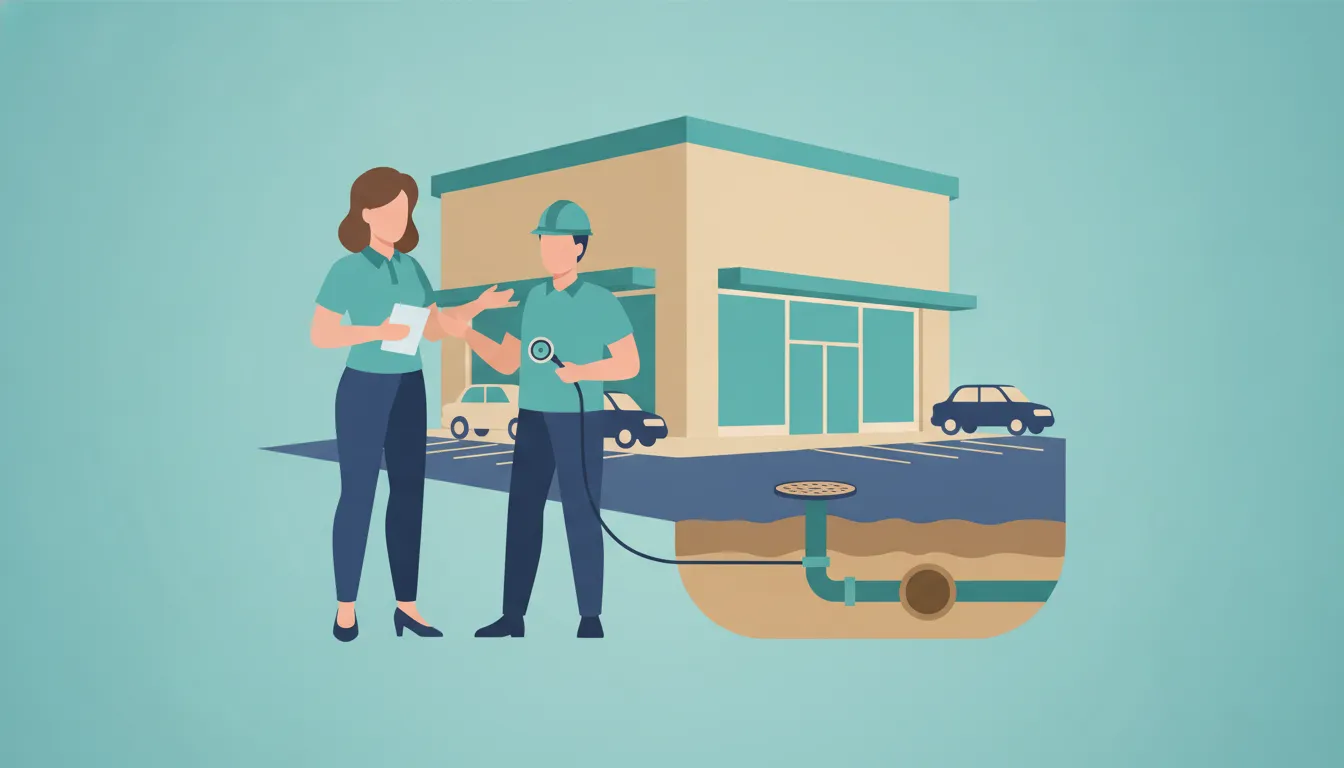
Commercial sewer line repair starts with the private lateral, the pipe that carries wastewater from the building toward the public main. A failure there can close restrooms, back up floor drains, and push work into occupied areas. Owners need a documented look at access, operating hours, and how far the damage runs before anyone picks a repair. The commercial sewer repair page is where that documented assessment gets scheduled.
Schedule a commercial sewer line assessment
What Is the Commercial Sewer Lateral an Owner Actually Controls?
The lateral is the private pipe between the building and the public connection. It is not the city main, and it is not a single floor drain inside a restroom. On a retail center, office, restaurant, hotel, or medical building, that pipe may cross a sidewalk, a drive lane, or a parking field before it reaches the main.
Responsibility is a local question. Some Florida utilities own the connection at the property line. Others stop at the main and leave the building sewer to the property. The U.S. Environmental Protection Agency explains that sanitary sewers collect commercial wastewater and that line breaks and blockages can release sewage. Local standards often place the private building sewer connection at the property line. Ask the utility which point is yours before you approve work on the public side.
That boundary matters on a multi-tenant site. A restaurant grease problem and an office restroom backup can share one lateral. Fixing only the suite that called first leaves the shared run untouched. Write down which buildings, which cleanouts, and which public manhole define the segment you are paying to repair.
Pipe Surgeons is a family-owned pipe specialist based at 750 NW Enterprise Dr #115 in Port St. Lucie. The company has served Florida homes and businesses since 1981 and covers Brevard, Indian River, St. Lucie, Martin, Palm Beach, Broward, and Miami-Dade counties. Technicians are licensed and insured. Commercial work is built around diagnostics first, then a repair that limits downtime for tenants, staff, and customers.
A commercial sewer pipe repair plan should name the pipe, the access points, and the hours the site can give up. Cleaning a grease line on a schedule is a different job. That belongs with a maintenance program, not with this repair decision.
Which Symptoms Mean You Need Commercial Sewer Line Repair?
Repeated backups in more than one fixture usually point past a single clog. One slow sink can be a local stoppage. The same backup in several restrooms, a floor drain that surcharges after rain, or sewage odor at a cleanout is a reason to look at the lateral.
Watch for these patterns before you approve another cleaning visit:
- Backups return within days after the line is opened.
- Several suites or floors are affected at the same time.
- A cleanout overflows during peak restroom or kitchen use.
- Wet ground, a sinkhole, or a depression appears along the pipe route.
- Camera notes from an earlier visit already showed cracks, offsets, or roots.
Grease, wipes, and scale can still be a cleaning problem. Hydro jetting and root removal have a place when the pipe wall is sound. If the same segment fails again, the next step is a repair decision, not another pass with a nozzle. Building drain lines inside the structure are a separate question from the lateral that leaves the building.
How Should a Camera Assessment Document the Lateral?
A useful assessment records the pipe, not just a verbal "it looks bad." Pipe Surgeons sends a camera through the line to find the stoppage and locate it. The same pass shows whether the wall can take a liner or needs replacement. On a commercial site, that record is what a property manager, owner, or facilities lead uses to approve the next step.
Ask for these items in the findings:
- Entry point, pipe material, and approximate diameter.
- Distance from the cleanout to each defect.
- Whether the defect is a clog, root mass, crack, offset, belly, or collapse.
- How much of the run is affected, not only the worst spot.
- Which access points exist, and which are blocked by tenants or pavement.
A sewer camera inspection is the starting record. Pipe mapping adds the layout when the route is unclear or when several buildings share a run. The EPA notes that map data should be checked against a physical inspection method such as closed-circuit television, because a drawing alone does not show the current condition.
Do not treat a sales walkthrough as the assessment. You want footage and distances you can share with a property manager, a landlord, or an insurer. That file is also what separates a spot repair from a full-run replacement.
Ask the technician to pause at each defect and name the distance on the recording. A still frame of a crack, without a footage mark, is hard to price later. If the camera stops at a collapse, say so in the notes. A partial run is not a full survey, and the scope should not pretend it is.
Commercial sites often have more than one cleanout. Try the downstream cleanout first when it is safe and open. Then work back toward the building if the camera cannot pass. Note roof cleanouts separately. A ground-level cleanout is a different access job than a roof cleanout, and that difference belongs in the written plan.
How Do Access and Operating Hours Change the Repair Plan?
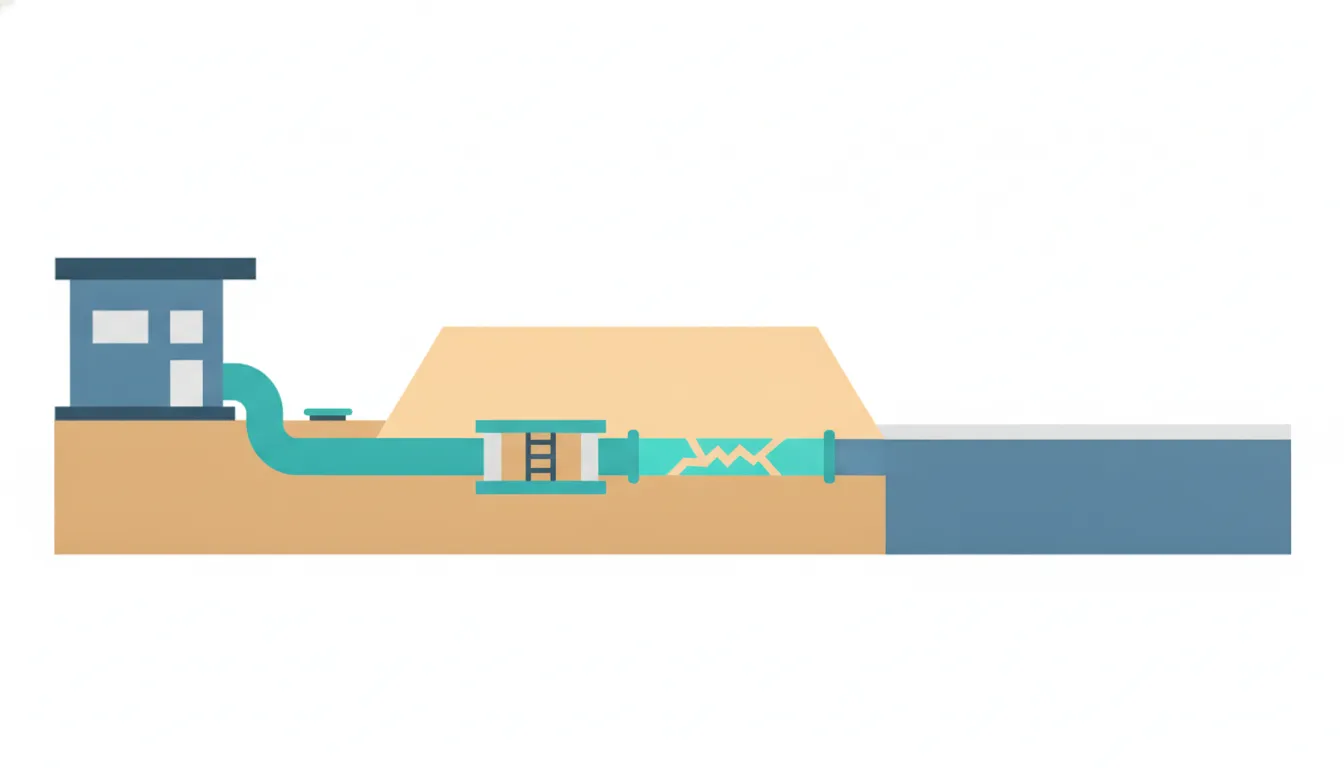
The same defect can need a different plan once the site constraints are known. A rear cleanout on a quiet service alley is not the same job as a line under a full customer lot at lunch. Commercial sewer line repair has to name who loses access, for how long, and what stays open.
Walk the site with the technician and write down the constraints:
- Where the cleanouts are, and whether a roof cleanout is the only entry.
- Which drive lanes, loading docks, or accessible routes cross the pipe.
- Hours when restrooms, kitchens, or clinical areas can be offline.
- Tenant notice rules and any after-hours window the lease allows.
- Where a small access pit could sit without closing the front door.
Pipe Surgeons plans commercial work to limit disruption. Open replacement can still be the right call when the pipe is collapsed or the host pipe will not hold a liner. The goal is to know that before pavement is opened.
Parking-lot design and HOA capital plans are their own topics. Here, access is only the constraint that changes which repair you can approve this week.
Put the operating window in the same note as the pipe findings. A liner cure or a bursting pull may need a continuous block of time, not a series of short visits between lunch rushes. If a clinic, hotel, or restaurant can only give up restrooms after closing, the crew plan has to match that window. Guessing at access after the proposal is signed is how a one-day repair turns into a tenant complaint.
Also mark what must stay live. Fire access, a loading dock, and an accessible entrance are not optional detours. If the only pit location blocks one of those, look for another entry or plan the work in phases. Pipe Surgeons will tell you when a trenchless option still needs a pit, so you can choose the spot before the schedule is locked.
How Do You Compare Repair Options After the Damage Is Known?
Match the method to the length and type of damage, not to a brochure. A short crack near a cleanout is not the same decision as a long run of offset cast iron under a drive lane. Pipe Surgeons favors trenchless methods when the host pipe can accept them, including slip lining and cured-in-place lining, and will still excavate when that is what the line needs.
| Approach | Fits best when | Access and disruption | Ask before you approve |
|---|---|---|---|
| Cleaning or root removal only | The wall is intact and flow is the only problem. | Usually a cleanout visit. | Will the same spot fail again? |
| Spot repair | One short defect, with sound pipe on both sides. | A small opening or an internal patch. | What length is actually repaired? |
| CIPP or slip lining | A longer run is cracked or root-cut, and the host pipe can hold a liner. | Access pits or cleanouts, with less surface restoration. | Will bends, diameter changes, and active connections still work? |
| Pipe bursting | The line should be replaced and a pit at each end is possible. | Two access points, not a full trench. | Is there room for the pits without closing the business? |
| Open replacement | The pipe is collapsed, badly belled, or cannot accept a liner. | A trench along the route, plus restoration. | Which pavement, landscaping, or tenant areas must be rebuilt? |
Trenchless pipe lining installs a new pipe inside the host when the path is suitable. Pipe bursting for a sewer drain line replaces the line by pulling a new pipe through and breaking the old one outward. Cast iron repair and replacement matters when older commercial buildings still have brittle iron laterals. Read the pipe relining versus pipe bursting comparison if you need the method detail. This article stays on the owner choice: extent of damage, access, and downtime.
No statewide price belongs in this decision. Depth, length, material, cleanout location, and restoration change the number. Get the scope in writing before you compare quotes.
Use the table as a filter, not a menu you order from. If the camera shows one bad joint and solid pipe on either side, start with a spot repair question. If roots or cracks repeat for a long stretch and the pipe still holds its shape, ask whether lining can rehab that stretch. If the pipe is broken into pieces, or a belly holds standing water the liner cannot correct, replacement is the honest conversation.
Active tie-ins deserve their own line in the notes. A lateral that also picks up a roof drain, a grease interceptor outlet, or a second building cannot be lined as if it were a simple house run. The proposal should say which connections stay open and how they are reinstated. That detail is part of commercial sewer line repair, not a change order discovered on site.
What Should the Written Scope Include Before You Approve Work?
Approve a scope that a second person could read and understand. Commercial sewer line repair proposals often mix cleaning, a short patch, and a full replacement in one price. Split them.
The scope should state:
- The pipe segment, from entry point to end point, with distances.
- The method, and why the camera findings support it.
- What stays in service during the work, and what must close.
- Restoration of pavement, landscaping, or interior access points.
- How the finished line will be checked before the crew leaves.
Permits and utility locates are part of the plan in many Florida cities, but the permit office is not a substitute for knowing the pipe. If the proposal cannot point to footage, ask for the assessment first. Call 811 before any digging so underground utilities are marked.
Pipe Surgeons keeps pricing up front and tells you the cost before work begins. Technicians are scheduled for the appointment window you set, with 24/7 emergency support when a backup cannot wait for the next business day. For a planned comparison of methods, use the contact form and ask for a documented assessment.
Request a documented sewer repair assessment
Share the finished scope with the people who will feel the shutdown. A property manager, a tenant contact, and the on-site engineer should see the same segment, method, and hours. If those three descriptions do not match, the proposal is not ready. Commercial sewer line repair goes more smoothly when the building knows which restrooms close and which doors stay open.
After the work, keep the camera file with the as-built note. The next backup should not start from zero. A short record of material, depth clues, cleanout locations, and the method used will save the next technician a full rediscovery. That habit also helps when ownership changes and the new owner asks what was done underground.
Plan commercial sewer line repair
Frequently Asked Questions
Who is responsible for a commercial sewer lateral in Florida?
It depends on the local utility. Many systems treat the building sewer as private up to the public connection, which may sit at the property line. Confirm that point with the utility before you authorize work on the public main.
Can a commercial sewer line be repaired without closing the parking lot?
Often, yes, when a cleanout or a small access pit can reach a pipe that will accept lining or bursting. A collapsed line under a drive lane can still require an open trench. The camera findings and the site walk decide that, not a general promise.
Is another drain cleaning enough?
Cleaning is enough when the pipe wall is sound and the backup is grease, scale, or a one-time clog. If the same segment fails again, or the camera shows cracks, offsets, or a collapse, plan a repair instead of another cleaning visit.
Does Pipe Surgeons only do trenchless commercial sewer line repair?
No. The company prefers trenchless lining and bursting when the host pipe and the access allow it, because that limits digging. Open repair remains an option when the line cannot be rehabilitated from the inside.
What should I send before the appointment?
Send any earlier camera notes, a site plan if you have one, and the hours when restrooms or drive lanes can be offline. Note whether the property is a restaurant, medical office, hotel, retail center, or multi-tenant building. That context changes the access plan.